
Single-storey or two-storey — which house to choose?
The choice is settled by the plot, not by the floor plan. We compare both against cost, comfort and what stays with you for decades.
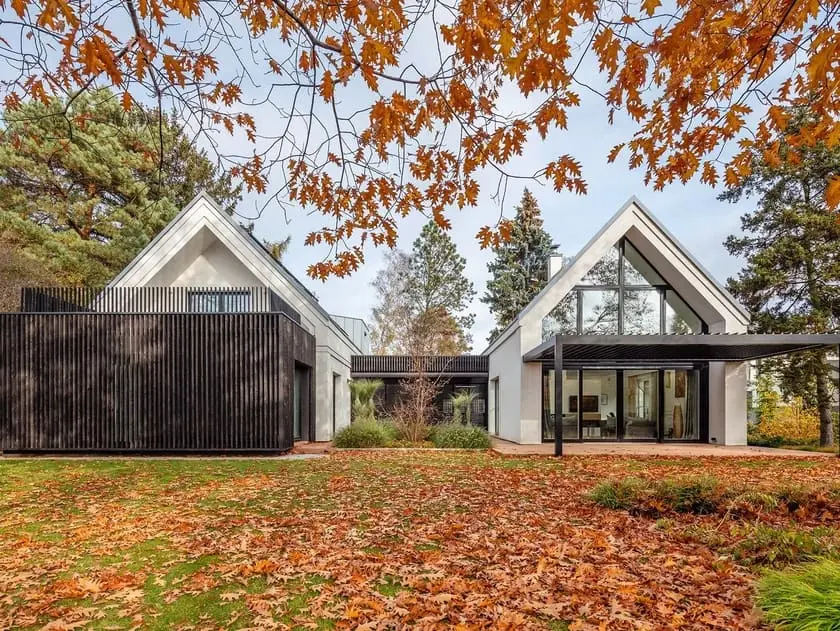
This question comes up at almost every first meeting. The answer starts not with preference but with the plot — because more often than not the plot settles it for you.
What decides before you do
The size and shape of the plot. A single-storey house of the same floor area covers twice the footprint. On a narrow plot, or within tight building lines, it simply does not fit.
The local plan. It may dictate the number of storeys, the roof pitch or the maximum height. We check this among the first things, before anything is drawn.
The slope of the ground. On a hillside a two-storey house is often the more natural answer, because one floor can sit into the slope. We designed a house that way in the Beskid mountains — set into the hillside, with a mountain panorama across the whole living area.
Cost: single-storey is not cheaper
This is the most common misconception. A single-storey house has twice the roof and twice the foundation slab for the same usable area. Those are the two most expensive elements of any build.
A two-storey house has more external wall area relative to its volume and needs a staircase, which takes a dozen or so square metres on two levels.
In practice the difference in construction cost is often small and depends on the particular design. The larger difference lies in running costs — and those are counted over thirty years, not two.
Comfort: it depends when
Single-storey wins over the long run. No stairs is something you do not appreciate at forty and appreciate a great deal at seventy. It is also easier to give every living room a direct connection to the garden.
Two storeys give a natural separation of day and night — no need to keep the corridor quiet once the children are asleep. They also give views that simply do not exist from the ground floor.
The garden: this is the biggest difference
A single-storey house eats the plot. If a large garden matters to you and the plot is not measured in hectares, a two-storey house will leave more of it.
The reverse happens too: on a very large plot, a single-storey house laid out along the ground can do something a two-storey house never will — run an entire life on one level, with views in several directions at once.
How we settle it in practice
We show several massing options and compare them against four things at once: light, views, cost of construction and future running costs. Alongside that we run a sunlight study in a 3D model, which shows where the sun falls at different hours and seasons.
Faced with that comparison, the decision usually makes itself. Not because anyone was persuaded, but because it becomes visible what the plot wants to give.